I analyzed 242,464 Indian tech jobs. Here are 9 hiring truths nobody on LinkedIn is telling you.
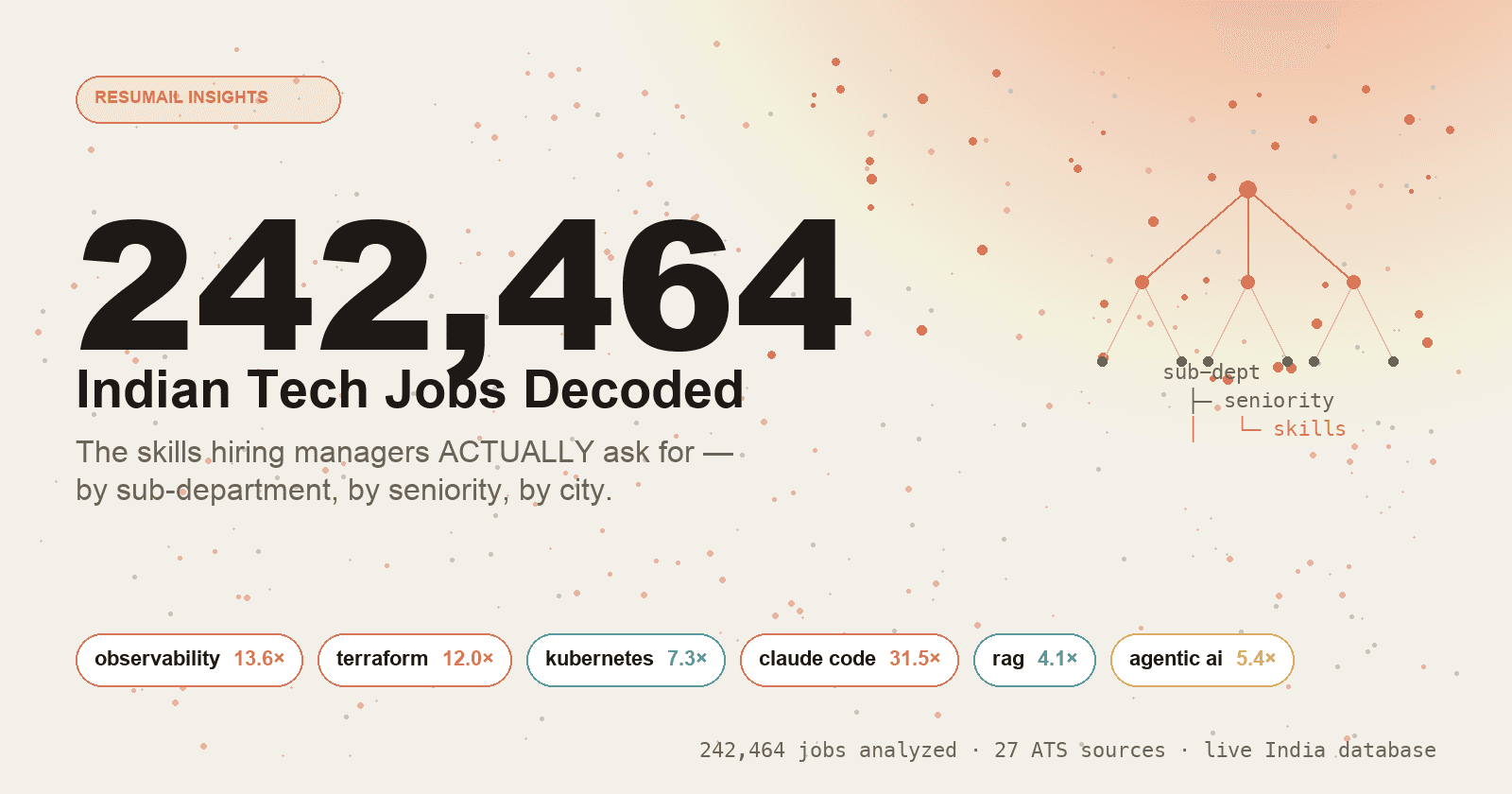
I analyzed 242,464 Indian tech jobs across 27 ATS sources. What I found will make every "Top 10 In-Demand Skills" LinkedIn post you've ever read feel like a fortune cookie.
This isn't a trend report. It's a forensic teardown of what Indian recruiters are actually typing into job descriptions in 2026 — sub-department by sub-department, seniority level by seniority level, city by city.
If you're an engineer, designer, recruiter, PM, or anyone deciding what to learn next quarter — read to the bottom. The decision matrix is at the end.
The setup (60 seconds)
- 242,464 Indian tech jobs analyzed across 27 ATS sources (greenhouse, lever, workday, ashby, smartrecruiters, bamboohr, darwinbox, keka, etc.)
- 42,464 currently active as of May 22, 2026 — the snapshot every chart below is computed from
- 35+ sub-departments × 7 seniority levels × thousands of unique skills
- All numbers are pure SQL on the production warehouse. No LLM "vibes" scoring. Reproducible.
So I asked the database the questions every Indian engineer, designer, recruiter, and PM has been Googling — but with actual data instead of LinkedIn hot takes.
Here's what fell out. Strap in.
🚨 #1: India is an Engineering Economy. It's not even close.
pie showData title Active India tech jobs by sub-department
    "Engineering" : 57.2
    "IT (other)" : 4.2
    "Data Science" : 3.5
    "Data Engineering" : 1.2
    "Customer Support" : 1.1
    "Infrastructure" : 1.0
    "Other 30+ sub-depts" : 31.8
| Sub-department | Active openings | Share |
|---|---|---|
| engineering | 24,295 | 57.2% |
| it-other | 1,790 | 4.2% |
| data-science | 1,472 | 3.5% |
| data-engineering | 528 | 1.2% |
| customer-support | 460 | 1.1% |
| infrastructure | 418 | 1.0% |
| accounting | 382 | 0.9% |
| security-engineering | 370 | 0.9% |
| product-management | 363 | 0.9% |
| enterprise-sales | 314 | 0.7% |
6 out of every 10 active tech jobs in India is a software engineer role. If you've ever felt like everyone around you is a SWE — they statistically are.
Now zoom out to seniority:
| Level | Openings |
|---|---|
| senior | 11,340 |
| entry | 8,473 |
| mid | 8,388 |
| manager | 4,533 |
| director+ | 1,012 |
| intern | 535 |
| fresher | 151 |
Only 151 jobs out of 42,000+ are tagged "fresher".
Companies don't post for "freshers" anymore — they post for "entry-level (0–2 yrs)". If you're a fresher applying to JDs tagged "fresher", you're competing in a pool of 151. Switch your filter to "entry" and your hit rate jumps 56×. This is a one-keyword fix that nobody tells you.
🌳 #2: The Skill Tree — what every sub-dept ACTUALLY asks for, by level
This is the chart nobody publishes. Top 5 skills per (sub-department × seniority), generic soft-skills stripped:
Engineering (24,295 jobs)
flowchart TD
    E[engineering · 24,295 jobs]
    E --> E1[entry]
    E --> E2[mid]
    E --> E3[senior]
    E --> E4[manager]
    E --> E5[director+]
    E1 --> S1[python · sql · data analysis · excel · java]
    E2 --> S2[python · ci/cd · sql · aws · java]
    E3 --> S3[python · ci/cd · aws · java · kubernetes]
    E4 --> S4[python · ci/cd · automation · pm · java]
    E5 --> S5[automation · governance · ci/cd · python · aws]
engineering/
├── entry      → python · sql · data analysis · excel · java
├── mid        → python · ci/cd · sql · aws · java
├── senior     → python · ci/cd · aws · java · kubernetes
├── manager    → python · ci/cd · automation · project mgmt · java
└── director+  → automation · governance · ci/cd · python · aws
Data Science (1,472 jobs)
data-science/
├── entry      → sql · python · data analysis · excel · power bi
├── mid        → sql · python · data analysis · power bi · data viz
├── senior     → python · sql · data viz · R · power bi
├── manager    → python · sql · data governance · pipelines · ML
└── director+  → ML · data governance · data quality · python
Security Engineering (370 jobs)
security-engineering/
├── entry      → security · compliance · siem · incident response
├── mid        → pentesting · incident response · python · cloud security · aws
├── senior     → incident response · python · cloud security · automation · powershell
├── manager    → secops · incident response · threat modeling · vuln mgmt · edr
└── director+  → python · secops · defender for cloud apps
Infrastructure / DevOps (418 jobs)
infrastructure/
├── entry      → ci/cd · python · c++
├── mid        → python · kubernetes · aws · troubleshooting
├── senior     → python · troubleshooting · terraform · automation
└── manager    → python · java · automation · project mgmt
Product Management (363 jobs)
product-management/
├── entry      → jira · ci/cd · sql · nosql
├── mid        → cross-functional · stakeholder mgmt · agile · backlog mgmt
├── senior     → stakeholder mgmt · powerpoint · project mgmt
├── manager    → cross-functional · stakeholder mgmt · product mgmt
└── director+  → stakeholder mgmt · team leadership · risk mgmt
Enterprise Sales (314 jobs)
enterprise-sales/
├── entry      → sales · negotiation · crm · market research
├── mid        → sales · negotiation · presentation · account mgmt
├── senior     → sales · negotiation · crm · forecasting · biz dev
└── manager    → sales · biz dev · negotiation · forecasting · crm
Recruiting (173 jobs)
recruiting/
├── entry      → sourcing · talent acq · onboarding · recruitment
├── mid        → sourcing · talent acq · stakeholder mgmt · interviewing · ATS
├── senior     → talent acq · sourcing · boolean search · interviewing
└── manager    → sourcing · stakeholder mgmt · talent acq · screening
The pattern that fell out: every domain follows the same arc — tools at entry, judgment at senior, people at manager, governance at director. Your craft changes more between levels than between functions.
🚀 #3: The 10× Skills — what actually separates "senior" from "entry"
I built a leveling-up index = senior_postings / entry_postings. A high ratio = "this is overwhelmingly senior territory" — skills you can't fake your way into.
For engineering:
xychart-beta
    title "Engineering skills: how senior-leaning is each one? (senior / entry mentions)"
    x-axis ["observability", "terraform", "mentoring", "distributed sys", "Go", "kafka", "microservices", "prometheus", "kubernetes", "github actions"]
    y-axis "Leveling-up multiplier" 0 --> 15
    bar [13.6, 12.0, 10.6, 10.0, 9.0, 8.9, 8.2, 8.1, 7.3, 7.0]
| Skill | Entry | Senior | Multiplier |
|---|---|---|---|
| observability | 42 | 570 | 13.6× |
| terraform | 57 | 685 | 12.0× |
| mentoring | 31 | 327 | 10.6× |
| distributed systems | 59 | 592 | 10.0× |
| security | 61 | 570 | 9.3× |
| Go (golang) | 40 | 358 | 9.0× |
| kafka | 54 | 478 | 8.9× |
| design patterns | 39 | 341 | 8.7× |
| microservices | 107 | 876 | 8.2× |
| prometheus | 30 | 242 | 8.1× |
| data pipelines | 45 | 347 | 7.7× |
| grafana | 39 | 288 | 7.4× |
| spring boot | 41 | 302 | 7.4× |
| kubernetes | 163 | 1,189 | 7.3× |
| github actions | 43 | 302 | 7.0× |
Translation: if you're an entry-level engineer asking "what should I learn to look senior?" — the answer is not React. Not "more Python." The market is paying a premium for systems-level fluency: observability tooling (Prometheus + Grafana + Datadog), Terraform, Kubernetes, Go.
Save this list. It's the cheapest career upgrade you'll find this quarter.
⚠️ #4: The Fresher Trap — keywords that cap your ceiling
The inverse: skills that mostly appear in junior postings and vanish at senior levels. Putting these front-and-centre on your resume signals "junior" louder than your years.
xychart-beta
    title "% of mentions at entry / fresher / intern level"
    x-axis ["data entry", "customer-service", "google sheets", "customer service", "teamwork", "multitasking", "english", "ms excel", "attention to detail", "coordination", "ms office"]
    y-axis "Junior-share %" 0 --> 100
    bar [85.3, 80.9, 72.4, 69.5, 67.9, 65.6, 62.8, 55.4, 54.9, 53.5, 53.3]
| Skill | % of mentions at entry/fresher/intern |
|---|---|
| data entry | 85.3% |
| customer-service | 80.9% |
| google sheets | 72.4% |
| customer service | 69.5% |
| teamwork | 67.9% |
| multitasking | 65.6% |
| english | 62.8% |
| ms excel | 55.4% |
| attention to detail | 54.9% |
| coordination | 53.5% |
| microsoft office | 53.3% |
None of these are bad skills. But if your LinkedIn headline reads "MS Excel · MS Office · Teamwork · Attention to Detail" — congratulations, the algorithm has filed you under "entry-level forever."
One terraform or observability keyword swings the recommendation graph in a completely different direction. Costs you a 10-second edit.
🤖 #5: The AI Earthquake — 90 days that rewrote every JD
I split the corpus into posted in the last 90 days vs posted before. The growth multipliers in AI/GenAI skills are tectonic:
xychart-beta
    title "AI / GenAI skill mention growth — last 90 days vs prior"
    x-axis ["claude code", "copilot", "agentic flows", "github copilot", "gen ai", "agentic ai", "genai", "vector dbs", "openai", "rag"]
    y-axis "Growth multiplier (×)" 0 --> 35
    bar [31.5, 21.0, 10.0, 8.1, 5.4, 5.4, 5.2, 4.4, 4.3, 4.1]
| Skill | Before 90d | Last 90d | Multiplier |
|---|---|---|---|
| claude code | 2 | 63 | 31.5× 🤯 |
| copilot | 3 | 63 | 21.0× |
| agentic workflows | 5 | 50 | 10.0× |
| github copilot | 16 | 130 | 8.1× |
| generative ai | 50 | 272 | 5.4× |
| agentic ai | 26 | 140 | 5.4× |
| genai | 42 | 217 | 5.2× |
| vector databases | 42 | 185 | 4.4× |
| openai | 18 | 78 | 4.3× |
| rag | 62 | 255 | 4.1× |
| claude | 18 | 74 | 4.1× |
| langchain | 60 | 219 | 3.7× |
| llms | 108 | 352 | 3.3× |
| prompt engineering | 107 | 306 | 2.9× |
"Claude Code" went from 2 mentions to 63 in a single quarter. A 31× jump.
Hiring managers are now literally writing "experience with Claude Code / GitHub Copilot" into job descriptions. AI tooling has crossed the line from nice-to-have into expected.
And — this is the wild part — it's not just engineering. Every sub-department is asking for some GenAI fluency:
| Sub-dept | AI/LLM skill mentions |
|---|---|
| engineering | 4,394 |
| data-science | 586 |
| infrastructure | 78 |
| it-other | 78 |
| product-management | 76 |
| data-engineering | 71 |
| security-engineering | 32 |
| product-design | 30 |
| general-ops | 19 |
| customer-support | 17 |
| supply-chain | 12 |
| accounting | 11 |
| recruiting | 8 |
| corporate-counsel | 8 |
Yes — even corporate counsel roles in India are now asking about LLMs. The horse has left the building. Catch up or be the slowest reviewer in the room.
☁️ #6: The Cloud Wars, city by city
For every Indian engineer's favourite question — "AWS or Azure?":
xychart-beta
    title "AWS mentions in active JDs by city"
    x-axis ["Bengaluru", "Hyderabad", "Pune", "Chennai", "Gurugram", "Mumbai", "Noida", "Delhi"]
    y-axis "AWS mentions" 0 --> 700
    bar [656, 433, 341, 143, 129, 116, 104, 35]
| City | AWS | Azure | GCP |
|---|---|---|---|
| Bengaluru | 656 | 465 | 304 |
| Hyderabad | 433 | 279 | 175 |
| Pune | 341 | 230 | 166 |
| Chennai | 143 | 98 | 69 |
| Gurugram | 129 | 95 | 92 |
| Mumbai | 116 | 79 | 74 |
| Noida | 104 | 79 | 49 |
| Delhi | 35 | 12 | 21 |
AWS leads in every Indian city. Azure is a close second in the NCR belt. GCP only edges out Azure in Delhi proper (because Google India's gravity sits in Gurugram).
Pick your cloud based on the city you want to live in, not the other way around.
🗺️ #7: The 30% City
pie showData title Share of active India tech jobs by city
    "Bengaluru (incl. Bangalore)" : 30.5
    "Pune" : 10.2
    "Hyderabad" : 9.7
    "Mumbai" : 8.3
    "Gurugram + Noida (NCR)" : 8.5
    "Chennai" : 5.4
    "Everywhere else" : 27.4
| City | Active jobs |
|---|---|
| Bengaluru | 8,712 |
| Pune | 4,335 |
| Bangalore* | 4,229 |
| Hyderabad | 4,107 |
| Mumbai | 3,513 |
| Chennai | 2,303 |
| Gurugram | 2,053 |
| Noida | 1,573 |
*Same city, two spellings. Collapse them and Bengaluru = 12,941 active openings. 30.5% of every active Indian tech job sits inside one city.
No other geography comes close. Pune (4,335) is the dark horse — it now out-hires Hyderabad and is closing in on Mumbai.
🏢 #8: The real top employers in India RN
Forget the consumer tech names dominating Twitter. The companies actually shipping the most JDs right now:
xychart-beta
    title "Top 10 Indian employers by active job postings"
    x-axis ["Amgen", "Barclays", "Google", "AccorHotel", "KPMG", "Hitachi", "HPE", "GE Vernova", "StateStreet", "Deloitte"]
    y-axis "Active openings" 0 --> 800
    bar [732, 687, 666, 539, 511, 499, 369, 324, 285, 284]
| Rank | Company | Active openings |
|---|---|---|
| 1 | Amgen | 732 |
| 2 | Barclays | 687 |
| 3 | 666 | |
| 4 | AccorHotel | 539 |
| 5 | KPMG | 511 |
| 6 | Hitachi | 499 |
| 7 | HPE | 369 |
| 8 | GE Vernova | 324 |
| 9 | State Street | 285 |
| 10 | Deloitte (USI) | 284 |
Pharma + banking + GCCs. India's job market in 2026 is being built by Global Capability Centres, not the names trending on LinkedIn.
👔 #9: The Manager Paradox
What skills define a manager-level role vs an IC role? I computed (manager+director) / (mid+senior) — high = "this is a leadership thing":
xychart-beta
    title "Leadership ratio: (manager+director) / (mid+senior) mentions"
    x-axis ["talent dev", "people mgmt", "hiring", "team-mgmt", "succession", "policy dev", "perf mgmt", "team leadership", "coaching", "strategic plan"]
    y-axis "Leader ratio" 0 --> 5
    bar [4.7, 4.2, 3.1, 2.4, 2.3, 1.8, 1.8, 1.7, 1.4, 1.3]
- talent development — 4.7×
- people management — 4.2×
- hiring — 3.1×
- team-management — 2.4×
- succession planning — 2.3×
- policy development — 1.8×
- performance management — 1.8×
- team leadership — 1.7×
- coaching — 1.4×
- strategic planning — 1.3×
If you want to break into management, the resume keywords that swing recruiter algorithms are NOT "leadership" (everyone says that).
It's the operational stuff: succession planning, performance management, policy development, talent development. Boring on Twitter. Promotion-worthy in JDs.
🎯 The TL;DR Decision Matrix — save this
If you're an entry-level engineer in India, the highest-ROI skills to learn next quarter are statistically:
- Terraform (12× leveling-up)
- Kubernetes (7.3×)
- Observability stack — Prometheus / Grafana / Datadog (8–13×)
- Go (9×)
- One GenAI tool — Claude Code or GitHub Copilot literacy. JDs are asking by name now.
If you're a mid → senior aspirant, lean into:
- Distributed systems vocabulary
- A managed/owned migration story (Kafka, microservices)
- Mentoring — 10.6× signal, the third-fastest growing senior keyword
If you're an IC → manager aspirant, get keyword coverage on:
- Performance management
- Hiring / succession planning
- Stakeholder management at scale
If you're a fresher, do this today: strip data entry · multitasking · ms-office · teamwork off your headline. Replace with one technical keyword (terraform, python, figma, tableau — anything domain-specific). The recommendation graph will reroute you within a week.
📦 Methodology (for the skeptics — I see you)
- Corpus: 242,464 Indian tech jobs analyzed across 27 ATS sources (greenhouse, lever, workday, ashby, smartrecruiters, bamboohr, darwinbox, keka, oracle_hcm, successfactors, workable, recruitee, phenom, peoplestrong, mokahr, kula, eightfold, google_careers, amazon, 3ds, html_scrape, custom_api, etc.)
- Active snapshot: 42,464 jobs as of May 22, 2026 — all charts and counts are from this snapshot
- Skills extraction:
skills_requiredarrays per posting, normalised to lowercase, no stemming - Seniority normalisation: 7 canonical buckets (intern → director_plus) inferred from title + JD
- Sub-department: 35+ canonical sub-depts inferred from title + JD
- All queries are SQL — no LLM-in-the-loop scoring. Reproducible numbers, not vibes.
If you want me to slice by your specific city / domain / company target, drop a comment with what you want. I'll run the query and reply.
Found this useful? Share it — your friend on LinkedIn looking at their "Top Skills" section needs it more than you think.
Built on the ResuMail job graph. Follow me for the next deep-dive — already cooking: "The 30 Indian companies with the most senior backend openings right now (and the skills they each prioritise)."